Every product has a price and every price tells a story. In this article we will explore how prices work and how brands should price their products. We will also dive deeper into pricing psychology and how customers are persuaded by the cost of an item.
Starting with a brief reference. In 2010, Warren Buffett told the US Financial Crisis Inquiry Commission that “the single-most important decision in evaluating a business is pricing power.” Pricing power means you can raise your price without losing customers to a competitor. If you need “a prayer session before raising the price by a tenth of a cent”, he said, you have a terrible business.
McKinsey looked at the average company in the S&P 1500. If it raised prices by 1% and sold the same amount, its operating profit would grow by about 8%.
What a price is made of
I break every price into two parts.
The first part is cost. It starts with landed COGS: the cost of making the product and bringing it to our warehouse, including freight and import duties. Then comes fulfilment, which is storing the product and packing each order. Then logistics, which is shipping the order to the customer.
The second part is the brand markup. This is everything the customer pays above the cost. It has to pay for marketing, the team, channel fees and, in the end, profit. How big the markup can be depends on how much value the brand logo can carry on top of the cost. I call this brand markup power.
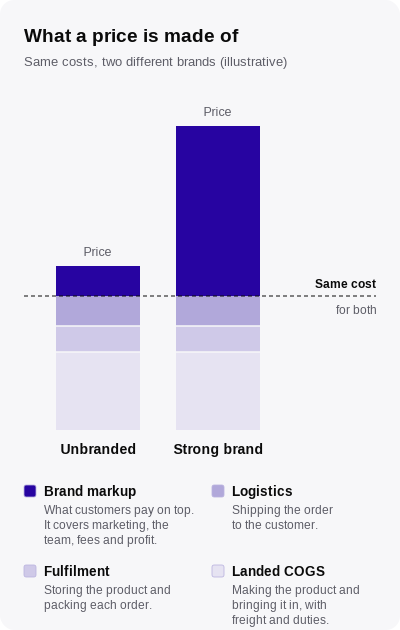
Customers never see your costs. They compare your price with other options and with what the product is worth to them. So cost only sets the lowest price you can accept. The brand decides how high you can go.
What lets a brand charge more
Every category has price bands, even if nobody writes them down. A plain white T-shirt can cost €9, €35, €90 or €400. Each band has its own buyers, shops and expectations. So when a brand picks a price band, it is also picking its customer.
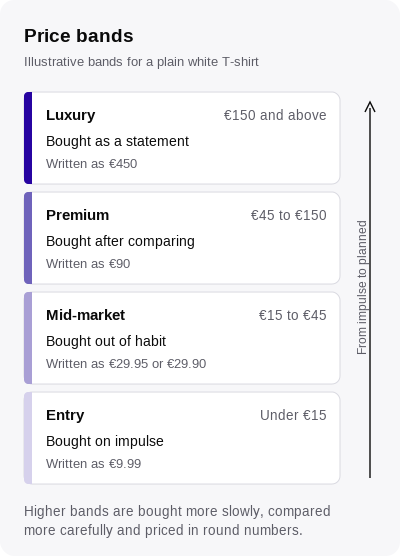
Moving up a band takes years. It starts with the product: better materials, better design and the same quality every time. Then comes trust, which a brand earns through reviews, good service and keeping its promises. On top of that, customers pay for what surrounds the product, like the story, the packaging, how rare it is and where it is sold.
When a higher price sells more
Pricing is also psychology. I have always been fascinated by how customers decide, which is why I studied psychology in business and economics.
Normally, when a price goes up, people buy less. Brands are often the exception.
In 1899, the economist Thorstein Veblen wrote about “conspicuous consumption”. It means buying things partly to show other people you can afford them. Economists later named Veblen goods after him: products people want more because they cost more. True Veblen goods are uncommon, but every brand people are proud to be seen with has a bit of this effect.
A higher price can even make a product feel better. In a 2008 study published in PNAS, researchers from Caltech and Stanford scanned the brains of 20 people while they tasted wine. People enjoyed the same wine more when they were told it cost $45 than when they were told it cost $5. The part of the brain linked to pleasure was also more active.
This is why price affects customer satisfaction. In 1980, the researcher Richard Oliver explained that customers are happy when a product meets or beats what they expected. The price sets that expectation. A higher price means the product has to deliver more.
A good way to test a brand’s price is the secondary market, where people resell what they bought. In 2026, an average Rolex still resold for about 10% more than its shop price, according to Morgan Stanley data reported by Forbes. Chrome Hearts, the Los Angeles brand founded in 1988, protects its prices by controlling where it sells. In 2019, when it opened its 32nd store, it still did not sell online. Its co-founder Laurie Lynn Stark said selling online would be “short-sighted”. On StockX, some Chrome Hearts pieces have resold for far more than they cost new.
A fun fact about price endings
Many prices end in .99 because of how we read numbers. We read from left to right, so €2.99 feels much cheaper than €3.00, even though the difference is one cent. Researchers Manoj Thomas and Vicki Morwitz call this the left-digit effect. In one test by Eric Anderson and Duncan Simester, a dress sold about a third more at $39 than at $34. The higher price sold more because it ended in 9.
Each ending sends its own signal:
- €9.99 says “this is a good deal”. It works best for cheap, quick buys.
- €9.95 and €9.90 say almost the same thing, but more quietly. They are very common in Europe.
- €10, or €10.00, says “this is the price”. It feels confident and premium, which is why luxury brands almost always use round numbers.
The right ending depends on how people buy. Impulse buys are quick and usually small, so a deal signal helps. Planned purchases take longer. People compare, read reviews and think about how long the product will last. For these, the price per use matters more than the price itself. A €300 coat worn 150 times costs €2 each time you wear it. A €60 coat worn 10 times costs €6. As Warren Buffett wrote, quoting his teacher Benjamin Graham: “Price is what you pay; value is what you get.”
Three prices for one product
Every price has a goal. It can aim for the most sales, the most profit or the most premium positioning, which means how high-status and desirable the brand looks. Each goal leads to a different price.
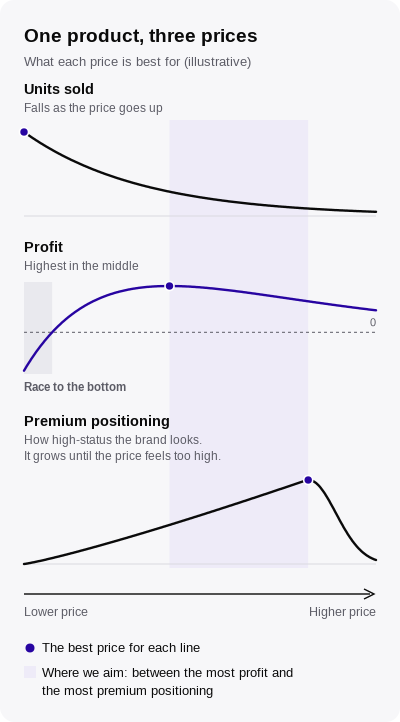
Price elasticity connects the three. It measures how much demand changes when the price changes. If you raise the price by 10% and lose 20% of your customers, demand is elastic. If you lose only 5%, demand is inelastic, and you have pricing power. A strong brand makes demand less elastic. That is what Buffett meant.
A strong brand is one people keep choosing, even when the price goes up.
On marketplaces like Amazon, price also highly affects the conversion rate, which is the share of visitors who buy. More conversions mean higher sales velocity, which is how fast a product sells. Amazon says its search looks at how often an item is bought, along with its price and delivery speed. Faster sales give a product more visibility and, over time, more market share.
That is how a race to the bottom begins. One seller cuts the price to rank higher. The next seller cuts it even more. Soon nobody is making money. When products are the same, price is the only thing left to compete on, and it keeps falling toward cost. A race to the bottom is something we never play on our brands. If a product can only win on price, we improve the product.
Low prices can be smart when they are part of a plan. A loss leader is a product priced low on purpose to bring customers in. Costco’s hot dog and soda has cost $1.50 since 1985, and in 2024 its finance chief told investors the price would stay. The best way to judge any low price is lifetime value. That is how much a customer is worth over all the years they buy from you. Michael Lewis studied this. Customers who joined with a 35% discount were worth about half as much over time as customers who paid full price.
Discounts in Premium and Luxury Brands
November is the month of discounts. A discount brings sales forward, but it also teaches customers to wait for the next one. In my experience, if a brand discounts too often, customers start to believe the lower price is the real price.
Premium brands can run sales, but carefully. They do it at the end of a season, on part of the range and not too often, so the full price still feels fair. Luxury brands almost never show discounts. In 2018, Burberry reported that it had destroyed £28.6 million of unsold goods in one year. Luxury brands did this to stop their products being sold off cheaply. After public criticism, Burberry stopped.
In Europe, since May 2022, any announced discount must show the lowest price of the previous 30 days. This stops shops from raising a price just before a sale to make the discount look bigger.
Raising prices only works if the demand for the product keeps up. Between 2019 and 2024, big luxury companies raised their prices by about a third on average, Reuters reported. Gucci’s revenue fell by more than a fifth in 2024 and again in 2025. Luca de Meo runs Kering, the group that owns Gucci. In July 2026, he told analysts: “in some categories, we kind of went too far and played with the elasticity.” Over the summer, Gucci quietly lowered prices on its website. A polo shirt went from €650 to €455 and a T-shirt from €550 to €385, nss magazine reported. A quiet cut avoids looking like a sale. But it shows how hard it is to win customers back once a price feels too high.
The brands that keep strong prices for decades raise them slowly, and only as fast as the product and the demand for it grow.
How we test prices
Nobody finds the right price on paper. We test prices the same way we test products, one change at a time, for a set period or in one market. We look at more than first-day sales. We also check conversion, returns, reviews, repeat purchases and the profit left at the end. Small changes teach the most, because they show where customers start to say no.
The art of pricing
Many brands adopt a purely rational approach to pricing, applying a formula and a markup to find the target range that hits their desired margin, which is fine. But the most powerful brands also complement that approach with an almost emotional layer on pricing, and the result is, in my eyes, almost an expression of art and intention, where brand positioning, product quality and the customer journey are all interconnected in perfect synergy. These prices come from knowing the product very well and understanding how customers feel when they see the price. They also need patience, to hold a price while the brand grows into it. Many times, that means starting at a sub-optimized pricing level to gain brand power in the future.
A price is also a promise. It tells customers what to expect. Price a great product too low, and it might not get the love it deserves.
At SVW, we build brands from first principles. For me, the art of pricing is one of the most important decisions we make for every brand.